GUIDESTEAM BUILDING
Remote team building with real gun turrets: how Shov's live arena works
If your team has done the trivia night, the online escape room and the cocktail kit, put them behind real full-auto gun turrets instead. Below: the formats that add something physical, how a Shov session runs minute by minute, what it costs at 10, 40 and 120 people, and who it suits.
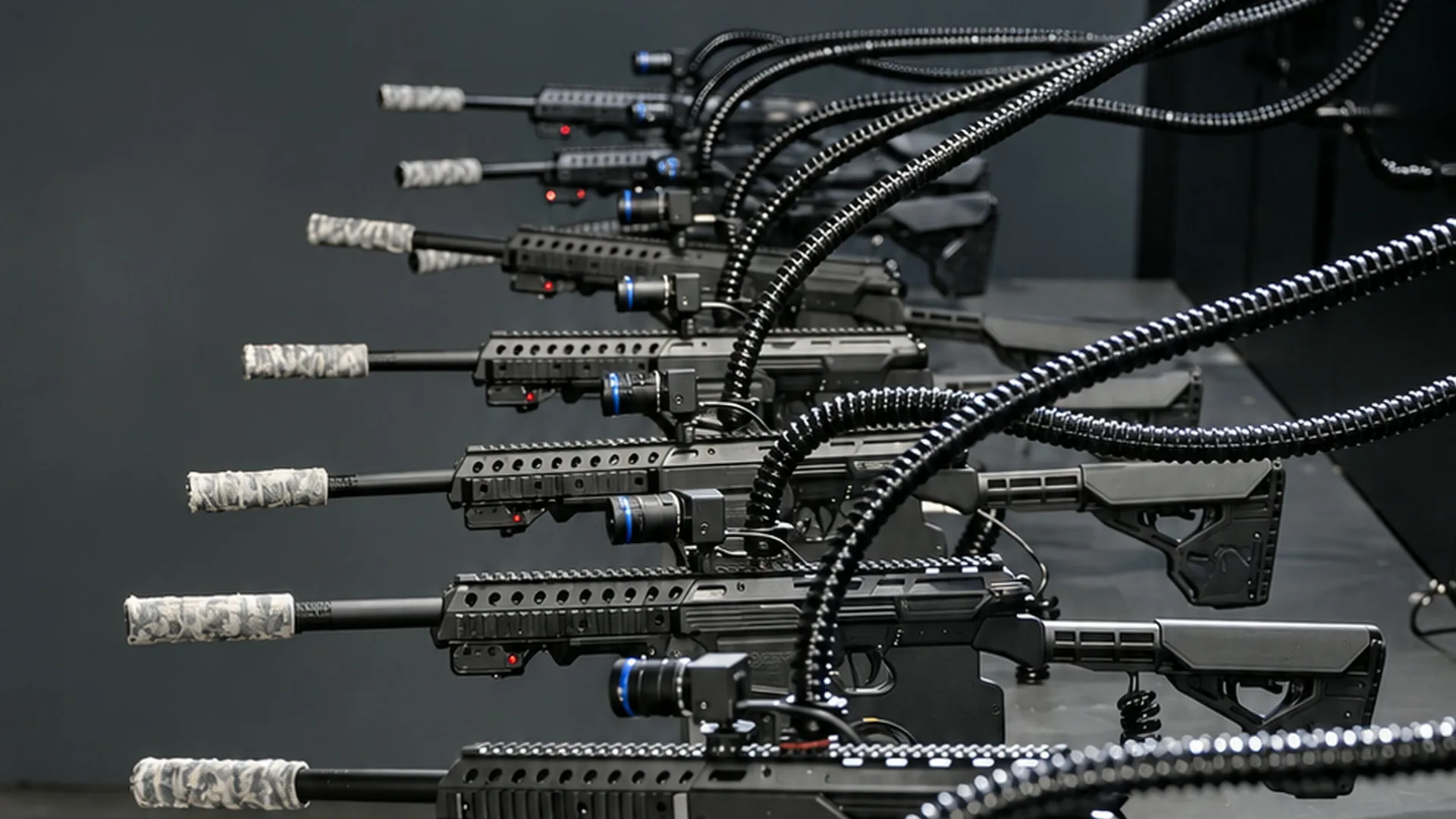
Short answer
Shov is a remote team activity for groups of 2 to 1,000 people, who control full-auto pneumatic gun turrets at a US shooting range from their browsers, up to 12 at a time. Groups play private 90-second matches with a team leaderboard. It costs $25–$50 per person depending on group size, with a $500 minimum per session, so groups under 10 pay more than $50 each.
Best for teams that want something fast, loud and competitive; not a good fit for organizers seeking a conversation-led activity.
- turrets, one per player in each match
- 12
- per match
- 90 s
- minimum per session
- $500
- arena matches since May 2026, almost all public, not group events
- 116,479
Alternatives to trivia and escape rooms with a real physical element
Most virtual team building happens entirely on screen: a host shares a quiz, a puzzle or a game, and everyone clicks along. A smaller set of formats adds something physical. They differ mainly in who is in control and how much work the organizer takes on.
- Hosted live tours: a guide with a camera walks through a brewery, a museum or a workshop. The place is real, but the team watches while the guide drives.
- Kit-based sessions: cooking, cocktails or tasting, with the same box shipped to every home. Everyone takes part, but the event requires collecting delivery addresses and coordinating shipping; international delivery and dietary requirements can add work.
- Remote-controlled hardware: each participant operates real equipment over the internet, with nothing shipped and nothing to set up at home. In Shov's arena, each player controls one gun turret at a US shooting range from their browser.
How a remote-controlled Shov arena session works
Shov runs a live arena at a shooting range in the USA with 12 full-auto pneumatic gun turrets that fire less-lethal .68 caliber rounds at targets. Each player controls one turret from a phone or laptop browser and watches it live. Aiming is point-and-shoot: click a green target and the turret turns there and fires. A match lasts 90 seconds. Each kill is a real projectile impact registered by a sensor on an active green target, and the player with the most confirmed kills wins the match.
- Pick a start time on shov.com/groups. Sessions can start on any half hour, day or night, shown in your own time zone, from later the same day to 90 days ahead. The session runs for as long as its matches take.
- Pay in full online by card, in USD. The organizer gets a calendar invite by email after payment.
- On the day, each player joins on their own phone or laptop in Chrome, Safari, Edge or Firefox. There is nothing to install, but they need a stable connection.
- For the whole session the 12-turret arena is reserved for your group, with no strangers in the lobby. Matches run back to back, and any group from 2 to 1,000 people rotates through them. Each match seats 12 players, or about half the group when it has 24 people or fewer. After playing, each person returns to the lobby and sits out at least the next match; in bigger groups the wait between turns spans more matches. A live AI announcer calls the kills and a private leaderboard tracks your group.
- After each match every player gets a highlight reel by email with your group's logo. After the session the organizer gets a recap video, an event page and a leaderboard image to share.
Shov for Groups opened on September 30, 2026, so it is a new event format. It runs on an arena that is not new: as of October 1, 2026, the arena had completed 116,479 matches since May 13, 2026. It completed about 930 a day in the last full week of September, almost all of them public matches.
What it costs
A match is one 90-second round of the whole arena for your group, and each costs $50. You pay per person at the rate for your group size, with a $500 minimum, and that amount buys whole matches. The quote on shov.com/groups shows the exact number of matches and the session length for your headcount.
| Group size | Price per person |
|---|---|
| 2–9 | $500 per session (minimum), so $250–$55.56 each |
| 10–19 | $50 |
| 20–49 | $40 |
| 50–99 | $35 |
| 100–199 | $30 |
| 200+ | $25 |
| Example | Total | Matches | Session length | Matches per person |
|---|---|---|---|---|
| 10 people | $500 | 10 | 15 min | about 5 |
| 40 people | $1,600 | 32 | 48 min | about 9.6 |
| 120 people | $3,600 | 72 | 108 min | about 7.2 |
To fill a longer calendar slot, add matches at $50 each. Each one adds 90 seconds of play, so 10 extra matches add about 15 minutes.
Who it suits: groups of every size
Groups are the best fit for Shov. Shov players constantly ask to play against their friends and coworkers, and a private session is exactly that: only your people in the arena, on one leaderboard. Matches run back to back, and each new 90-second match starts the moment the last one ends, so turns come round fast and everyone plays several times. Rotation is seamless: there is no gear-up, briefing or reset between turns, as there is between go-kart heats.
- Large groups, all the way up to 1,000 people. Players rotate 12 at a time, and everyone gets multiple turns: at 40 people each person plays about 10 of 32 matches, and at 120 people about 7 of 72. Add matches to give everyone more turns.
- Short waits between turns. In a group of 24 or fewer, you sit out one 90-second match between turns. At 40 people the wait is about 3.5 minutes.
- Distributed teams across several time zones, and holiday parties or kickoffs that want a high-energy competitive block.
- Hybrid teams. People in the office and people at home play on equal terms, because everyone is remote from the arena. Everyone in the office joins from their own phone or laptop.
- Small groups too. With 4 people, half the group plays each match; the $500 minimum buys 10 matches, about 15 minutes of play, and you can add matches for a longer session.
- Less of a fit: a team that wants a long, quiet, conversation-led activity. A session is fast and competitive by design.
Is it a good team building activity for engineers?
The appeal is the direct feedback loop: a browser command turns a physical turret and fires it. Scoring is not simulated: a kill counts only when a target sensor registers a real projectile impact on an active green target. Each pneumatic turret can fire at up to 16 rounds per second, and every player watches their own turret on a live feed. It is competitive and hardware-led rather than a facilitated discussion.
How it compares with the usual options
| Format | Physical element | Who is in control | Organizer and player setup |
|---|---|---|---|
| Trivia or quiz night | No | Everyone answers | Low |
| Digital escape room | No | The team solves software-based puzzles | Low |
| Live-guided physical escape room | Yes, at the venue | Players direct a guide inside the room | Low; runs over a video call |
| Kit-based session (cooking, cocktails) | Yes, at home | Everyone | Varies: may require addresses, shipping coordination and dietary checks |
| Hosted live tour | Yes, on camera | The guide | Low |
| Remote-controlled arena (Shov) | Yes, real gun turrets | Each player, one turret per match | No shipping; each player needs a supported browser and a stable connection |
FAQ
What do the turrets fire, and at what?
The 12 full-auto pneumatic gun turrets fire less-lethal .68 caliber rounds at up to 16 rounds per second at sensor targets in a live arena at a shooting range in the USA. Every hit a target's sensor registers counts as a kill.
What do players need?
A phone or laptop with Chrome, Safari, Edge or Firefox, and a stable connection. There is nothing to download.
How many people can join?
Groups of 2 to 1,000 can book. Up to 12 people play each 90-second match and the rest rotate in, and the quote shows the exact number of matches and session length for your headcount.
How much does it cost for a team of 10?
$500 in total. That buys 10 matches, about 15 minutes of play, and each person plays about 5 of them. To extend the session, add extra matches at $50 each.
How long is a session?
It depends on headcount. Each match lasts 90 seconds and matches run back to back, so 10 people get about 15 minutes, 40 people about 48 minutes and 120 people about 108 minutes. Add matches at $50 each to extend the session.
How far ahead do we need to book?
Sessions can start on any half hour, 24 hours a day, from later today up to 90 days ahead. You pay in full online by card in USD, and the organizer gets a calendar invite by email after payment.
Can we play outside US business hours?
Yes. The arena runs 24/7 and a session can start on any half hour, so teams in Europe or Asia can play during their own working day.