GUIDESTEAM BUILDING
Company competition score sheet: a team challenge with real gun turrets
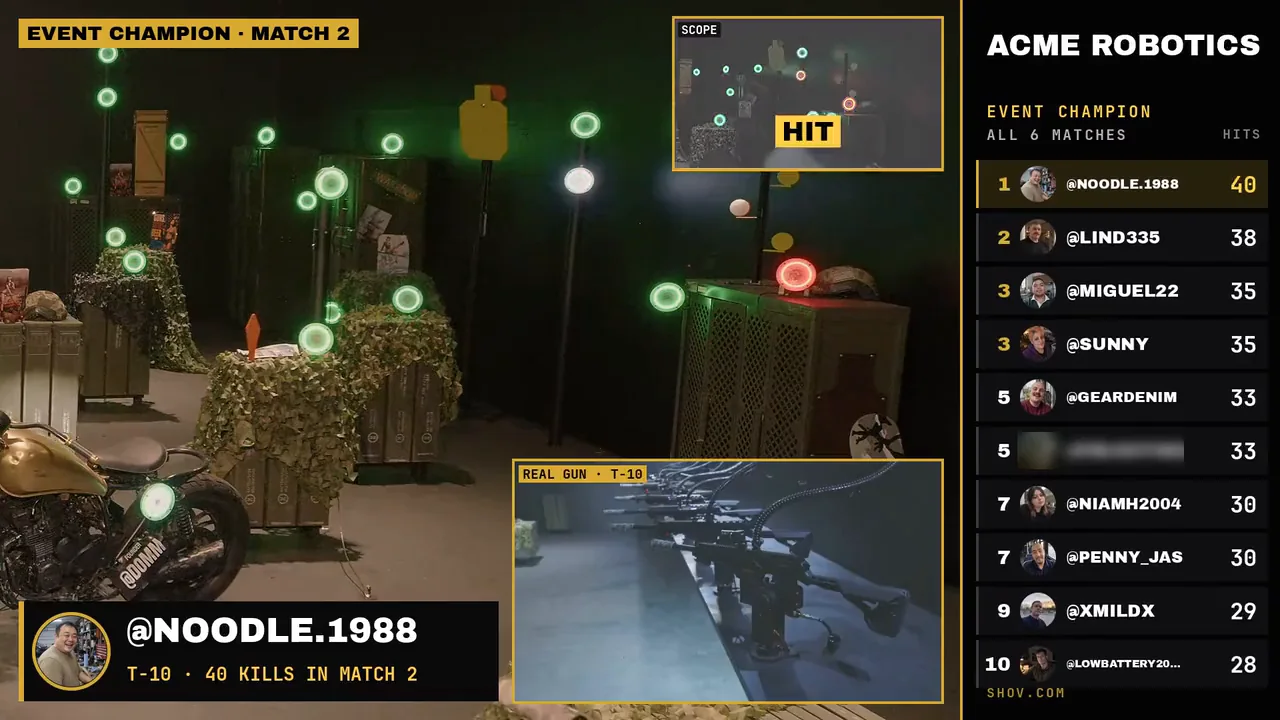
Give a whole-company arena day one shared challenge: mixed teams of four, three scored rounds per person and a team total from those twelve results. Colleagues can play throughout the booked day. The company keeps this challenge sheet alongside the arena’s own standings.
The scoring rule
Create teams of four before the event. Count each person’s first three completed rounds during the confirmed booking. Add their confirmed kills for an individual total, then add the four individual totals for the team. The organizer records results and publishes the challenge table; additional rounds remain part of the arena day.
Shov is a real gun turret range controlled from a phone or laptop browser. The turrets fire less-lethal .68 caliber rounds at sensor targets. Up to 12 colleagues play each 90-second match. Matches run back to back, so an arena day can stay open while staff move between work and competition.
Set up mixed teams before the day
Use four-person teams with colleagues from different departments. For 200 entrants, that creates 50 teams and gives every scored team the same number of players and counted rounds. Team members do not have to occupy the same match or play together. Their recorded results accumulate during the booked window.
Freeze the scored roster before play starts and assign each entrant to one team. If the entrant count is not divisible by four, invite colleagues to complete the last team. A team with fewer than four entrants can participate in the arena and individual results, but stays outside this four-person team table. State that rule in the invitation. Playing in the company event does not require entering this optional challenge.
Copy these score-sheet columns
| Column | What to record |
|---|---|
| Team | The four-person team name |
| Player | The entrant’s exact arena handle |
| Department | The company department used for introductions |
| Round 1 / 2 / 3 | Confirmed kills in the entrant’s first three completed booking rounds |
| Round evidence | A saved round-board screenshot showing the handle and confirmed kills for each counted round |
| Player total | Round 1 + Round 2 + Round 3 |
| Complete | Yes only when all three results have been checked |
For a spreadsheet with the three round values in D2:F2, use =IF(COUNT(D2:F2)=3,SUM(D2:F2),"") for the player total. This preserves an incomplete row as blank while counting a genuine zero. Ask entrants to submit a screenshot after each of their first three completed rounds. The organizer checks each screenshot’s handle and confirmed kills, rejects duplicate submissions and marks the row complete after all three results are verified. Copy the formula down for the roster.
Accept a team total only when all four player rows are complete. Sum the four player totals and sort from highest to lowest. Keep the source rows so colleagues can check how the result was calculated. These are manual company rules; Shov does not assign these teams or calculate this twelve-result challenge table.
Use one rule for repeats and ties
Count the first three completed rounds, even if a later round scores higher. Additional rounds are welcome throughout the reservation and contribute to the arena experience, but do not replace counted results in this challenge. After a match, players return to the lobby, sit out the next round and can queue again.
At the confirmed booking end, close the challenge sheet. An entrant with fewer than three verified results remains incomplete; do not substitute zero for a missing round. Publish incomplete teams separately from the scored table. Teams with equal totals share the same place. Award a shared first place if the highest totals tie; no extra match beyond the booked window is required.
| Example team | Four verified player totals | Team total | Challenge place |
|---|---|---|---|
| Gold | 24 + 18 + 21 + 27 | 90 | Joint first |
| Range | 20 + 22 + 25 + 23 | 90 | Joint first |
| Orbit | 19 + 20 + 18 + 25 | 82 | Third |
Plan capacity for the counted rounds and repeat visits
| Private window | Company total in USD | Arena matches | Player slots, including repeats |
|---|---|---|---|
| 1 hour | $2,000 | 40 | 480 |
| 4 hours | $4,000 | 160 | 1,920 |
| 8 hours | $7,000 | 320 | 3,840 |
For 200 challenge entrants, three counted rounds each use 600 player entries. An 8-hour company day provides 3,840 player slots, including repeat visits. That is planning capacity, not a promise that each entrant will complete the challenge. Encourage colleagues to record their three rounds early, then return throughout the workday.
The package price covers the arena window; expected headcount does not change that fixed total. Choose the duration, date and available start time on Shov for Groups, then complete verified-email checkout and payment. Use the paid booking’s participant joining instructions in the invitation. Choose the company arena window
Report participation without counting repeat players twice
Keep four separate numbers in the recap: distinct people who played, total player entries across matches, entrants who completed three scored rounds, and complete four-person teams. Count distinct people from the organizer’s deduplicated handle roster. A player returning five times contributes one person and five entries.
Publish the company challenge table with its rule, cutoff and shared-place convention. Link to the arena results separately. Neither an open seat count nor a company challenge total measures improved morale or collaboration. Ask colleagues for direct feedback if you want to understand their experience.
Use the invitation kit to send the confirmed arena window and joining instructions, then attach this challenge rule in the company channel. Company gun turret event invitation kit
FAQ
Does Shov calculate this company challenge table?
The company organizer owns the four-person teams, score sheet and twelve-result team calculation. Keep that table distinct from Shov’s arena standings.
Can people play after their three scored rounds?
Yes. Colleagues can keep returning during the booked arena window. This challenge counts only their first three completed rounds; later rounds do not replace those results.
What happens when team scores tie?
Teams with equal totals share a place, including first place. Publish that rule before the event and close the sheet at the confirmed booking end.