GUIDESTEAM BUILDING
A gun turret rally for a customer support team on shifts: a coverage plan
A customer support team cannot leave the queue for an afternoon. It can run a gun turret rally all the same: Shov's private arena at a secure US range runs 24/7, a match lasts 90 seconds, and the organizer's coverage plan lets half of each shift drop in between tickets while the other half holds the phones and chats. Here is the coverage plan, a shift-by-shift schedule inside one booking, the budget for 40 to 150 agents and the organizer's checklist.
The short answer
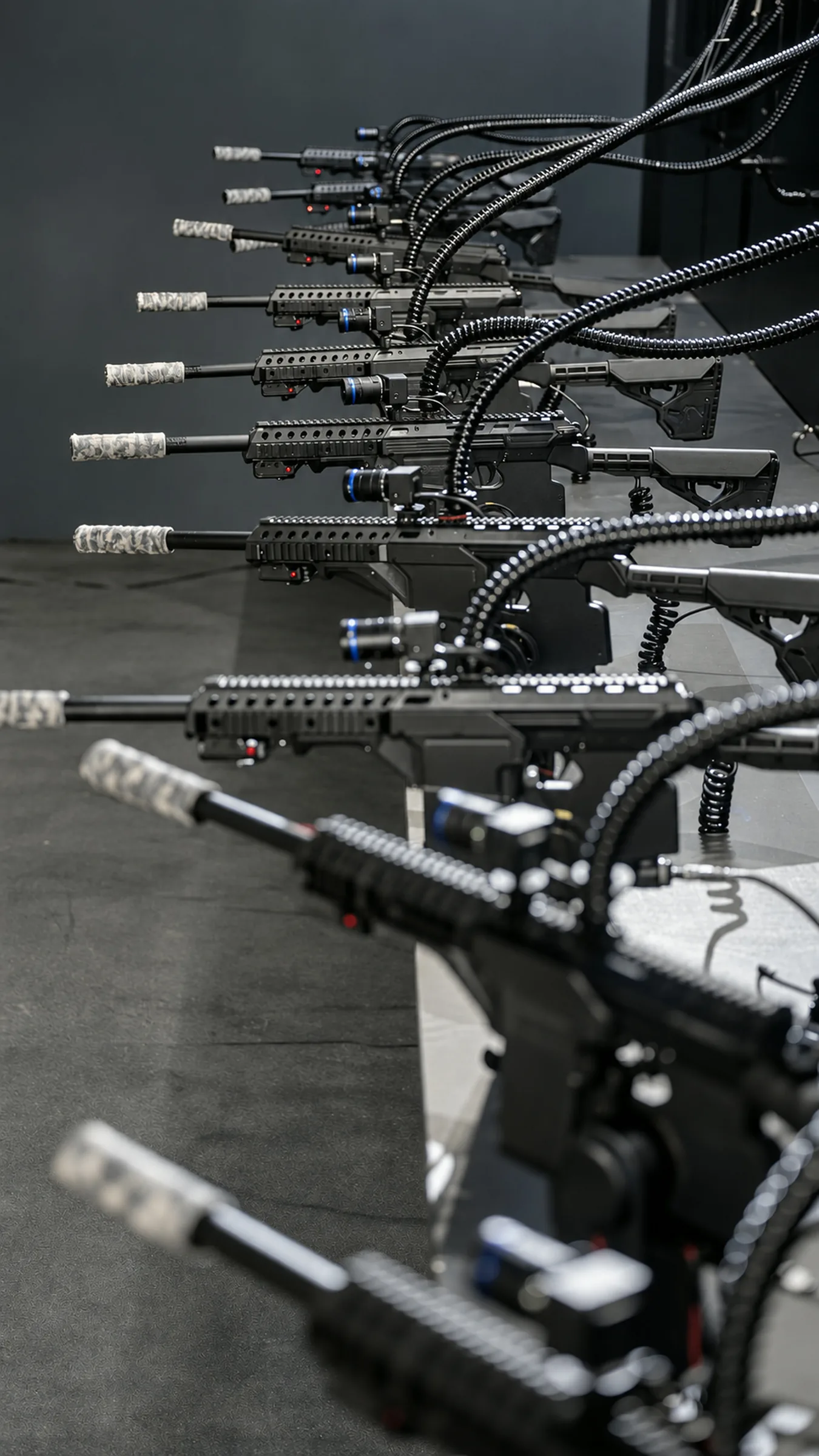
Book Shov's private gun turret arena for one 10-hour window across your shift handover and split each shift into two pods: one pod drops into the range between tickets while the other holds the queue, then they swap. Every agent controls a real gun turret from the browser they already use, firing less-lethal .68 caliber rounds at sensor targets.
- per match, so one turn is one short gap between tickets
- 90 s
- gun turrets in every match
- 12
- player slots an hour, matches back to back
- 480
- arena hours at the US range, for every shift
- 24/7
Why a gun turret rally fits a team that works the queue
A support floor runs on coverage. Phones, chat and tickets keep arriving through every shift, so an activity that takes the whole team away at once is off the table, and most team socials end up as a video call squeezed into the quietest hour. A gun turret rally works the other way round. The arena is private to your booking for the whole window, matches run back to back for 90 seconds each, and an agent who has just closed a ticket plays one match and then takes the next ticket. Under the organizer's pod rule only the on-range pod drops in, one match at a time, so at most 12 agents are on gun turrets while the holding pod stays on phones, chat and tickets. That is the organizer's rule for the day, not a lock inside the booking.
The rotation does the pacing for you. After a match the product returns the player to the lobby to sit out the next match, after which they can rejoin; that is all the rotation does. The pod plan, not the rotation, sends the agent back to a ticket between turns and keeps the other pod on the queue. At most 12 people play one match, and Shov fills each match from whoever is in the lobby. A two-hour rally window offers 960 available player slots, far more than a pod of 16 agents can use, so the pod has room for several turns each.
Every agent gets the same controls. Each person opens the event invitation on their own laptop or phone, controls a real full-auto pneumatic gun turret from that browser and fires less-lethal .68 caliber rounds at sensor targets at up to 16 rounds per second. Click or tap an active green target; the gun turret turns there and fires, and a confirmed projectile impact on an active target counts as a kill. Most confirmed kills wins the match. A live AI announcer calls every match, and the private team leaderboard ranks everyone in the booking for the whole session. Agents at home or in a second office join the same event from their own browsers.
A shift-by-shift schedule inside one private booking
The sample team below has 80 agents on three eight-hour shifts: a day shift of 32 (07:00–15:00), an evening shift of 28 (15:00–23:00) and an overnight shift of 20 (23:00–07:00), all in America/Chicago, the support hub's clock and the one reference zone in this guide. The plan is for Thursday, November 12, 2026. One 10-hour pass, 11:00–21:00 CST, straddles the 15:00 handover: the day shift plays its last four hours, the evening shift plays its first six, and both shifts share one invitation and one leaderboard. Shov's scheduling configuration keeps the arena clock in America/Denver, so the arena window reads 10:00–20:00 MST (17:00–03:00 UTC); every time below was converted at render time from the hub's IANA time zone.
| Rally window | Hub clock (America/Chicago) | Arena clock (America/Denver) | UTC | On the range | Holding the queue |
|---|---|---|---|---|---|
| Day shift, rally window 1 | 11:00–13:00 | 10:00–12:00 MST | 17:00–19:00 | Day pod A drops in between tickets | Day pod B holds the queue |
| Day shift, rally window 2 | 13:00–15:00 | 12:00–14:00 MST | 19:00–21:00 | Day pod B drops in between tickets | Day pod A holds the queue |
| Shift handover | 15:00–15:30 | 14:00–14:30 MST | 21:00–21:30 | Day shift turns ended at the shift's close; the evening shift gets the one-minute controls brief and its first drop-ins | Evening shift takes the queue as it arrives |
| Evening shift, rally window 1 | 15:30–18:00 | 14:30–17:00 MST | 21:30–00:00 | Evening pod C drops in between tickets | Evening pod D holds the queue |
| Evening shift, rally window 2 | 18:00–20:30 | 17:00–19:30 MST | 00:00–02:30 | Evening pod D drops in between tickets | Evening pod C holds the queue |
| Evening close, first half | 20:30–20:45 | 19:30–19:45 MST | 02:30–02:45 | Evening pod C takes its last turns | Evening pod D holds the queue |
| Evening close, second half | 20:45–21:00 | 19:45–20:00 MST | 02:45–03:00 | Evening pod D takes its last turns; the scorekeeper reads out the evening shift champion at the close | Evening pod C holds the queue |
Each shift is split into two pods of roughly equal size and skill mix, with each pod's agents paired to a counterpart in the other pod who covers their channel. The pod on the range does not leave the floor together: agents drop in one match at a time, between tickets, as the queue allows. The pod holding the queue takes the overflow. At the end of the window the pods swap, so both halves of the shift play inside their own working hours, and the holding pod keeps every channel covered for the whole window under the organizer's rule. The day shift's turns end when its shift ends at 15:00. The half-hour handover window is the evening shift's warm-up: a one-minute controls brief and the first drop-ins while the queue changes hands. The evening close is split in two so each evening pod takes its last turns while the other holds the queue.
The overnight and weekend shift gets its own session
The overnight shift works 23:00–07:00, outside the pass. Sessions start on any half hour, 24 hours a day, chosen in your own time zone, and the arena runs around the clock, so the overnight shift books its own per-person session on a quiet night. In the example it plays on Saturday, November 14 at 02:00 CST: 20 agents, $800 for 16 back-to-back matches, 24 minutes. Night pod E drops in during the first half and night pod F during the second, with the other pod on the queue: one 12-minute window per pod of 10 agents, 8 matches per window, so at most 4 matches per agent under the sit-out rotation.
| Overnight session | Hub clock (America/Chicago) | Arena clock (America/Denver) | UTC | On the range | Holding the queue |
|---|---|---|---|---|---|
| Saturday, November 14, night pod E | 02:00–02:12 | 01:00–01:12 MST | 08:00–08:12 | Night pod E drops in between tickets | Night pod F holds the queue |
| Saturday, November 14, night pod F | 02:12–02:24 | 01:12–01:24 MST | 08:12–08:24 | Night pod F drops in between tickets | Night pod E holds the queue |
Organizer plan: scorekeeping, shift champions and the queue hero
Shov runs the matches, shows a round board ranked by confirmed kills after each one, and ranks every player in the booking on one private team leaderboard across the whole session. The organizer turns that into a rally with shift standings. Everything below lives in your own sheet and your own channels; none of it is a setting inside the event, and Shov does not assign named agents to a match or show per-shift tables.
- The rally sheet. One sheet with a line per agent and columns for shift, pod, each match's confirmed kills, best match and queue-hero points. Name one scorekeeper per shift; the shift lead is the usual choice.
- Reporting a match. After each match the game shows a round board ranked by confirmed kills. The agent posts their confirmed kills from that board in the shift channel, and the scorekeeper records the figure against the agent's line. The best single match is each agent's rally score.
- Shift champion. When a shift's last window closes, the agent with the highest best match in that shift's windows is the shift champion. A tie goes to the higher second-best match, and an agent with only one completed match counts a second-best of zero; if the second-best figures are also equal, the title is shared. An agent with no completed match is not in the champion ranking and stays eligible for the queue hero only. The overnight shift's champion comes from its own session the same way.
- Queue hero rule. An agent earns one queue-hero point for each rally window in which their own pod is on the range and they hold the queue for the whole window instead of dropping in. The points live in the rally sheet. When the shift closes, the agent with the most queue-hero points is the shift's queue hero; ties are shared. The queue hero is announced alongside the shift champion, every time.
- Team champion. The overall champion is the agent with the highest best match on the rally sheet across all three shifts and both bookings, decided with the same tie-break as the shift champions in step 3. Copy the overnight session's confirmed kills onto the same sheet by hand first. Shov's team leaderboard ranks every player in one booking across the whole session; it does not show best-single-match or per-shift tables.
Budget: a per-person session or a day pass
Per-person sessions are priced by group size with a $500 minimum per session. Current tiers per person: 2–19 people $50; 20–49 people $40; 50–99 people $35; 100–199 people $30; 200+ people $25. Each $50 of a booking buys one complete arena match for the whole group, and a per-person session runs its matches as one continuous block from the booked start. Day passes reserve the arena for a fixed window at a fixed price, however many agents drop in. All prices are in USD, paid by card at booking; the calendar invite follows by email.
| Agents | Session total | Per agent | Matches | Session length | Matches per agent |
|---|---|---|---|---|---|
| 40 | $1,600 | $40 | 32 | 48 min | 9.6 |
| 80 | $2,800 | $35 | 56 | 84 min | 8.4 |
| 150 | $4,500 | $30 | 90 | 135 min | 7.2 |
The shift-by-shift plan needs the arena open across a handover, which is what a day pass is for. The 10-hour pass at $14,000 keeps the arena open 11:00–21:00 CST for 400 back-to-back matches and 4,800 player slots. For the 60 agents on the sample day and evening shifts that is 80 available slots per agent, and if the whole 80-person team dropped in it would be 60: both figures are available-capacity averages, the pass's player slots divided by the expected headcount, and actual turns follow attendance, the pod plan and how often agents rejoin. The 5-hour pass at $8,000 covers one shift's rally windows plus a handover; a 24-hour support operation can book one pass per shift pair.
| Private window | Fixed total, USD | Matches | Per expected agent at 40 | Per expected agent at 80 | Per expected agent at 150 |
|---|---|---|---|---|---|
| 5 hours | $8,000 | 200 | $200 | $100 | $53.33 |
| 10 hours | $14,000 | 400 | $350 | $175 | $93.33 |
| Private window | Player slots | Slots per agent at 40 | Slots per agent at 80 | Slots per agent at 150 |
|---|---|---|---|---|
| 5 hours | 2,400 | 60 | 30 | 16 |
| 10 hours | 4,800 | 120 | 60 | 32 |
Bigger teams get more from every option. The per-person tiers fall as headcount rises, a day pass costs the same whether 60 agents or 300 drop in, and a support organization that brings its sales floor, its success managers and its back office into the same pass fills more of the 4,800 slots it has already paid for. Bookable group sizes run from 2 to 1,000 people, same day up to 90 days ahead.
Organizer checklist
- Pick the date and the reference zone. Put the arena window in your hub's zone, in America/Denver and in UTC on the invitation, then list each shift's rally windows in the hub's clock. Avoid dates near a daylight-saving change.
- Book the window in the planner. Choose the 10-hour pass for a two-shift plan across a handover, the 5-hour pass for one shift, or a per-person session for a single shift such as the overnight team. Start times are on any half hour in your own time zone; confirm the window matches your schedule table.
- Split each shift into two pods. Balance channels and skills so the pod holding the queue can cover every channel on its own, and pair each agent with a counterpart in the other pod.
- Name a scorekeeper per shift and set up the rally sheet with the shift champion rule and the queue hero rule written at the top, so every shift scores the same way.
- Send one invitation per booking with the full schedule. The pass has one private event link and one leaderboard; the overnight session has its own. Anyone with the invitation or a verified email on your company domain can join at any time between start and end, which is what lets agents drop in between tickets.
- Brief the controls once per shift, in a minute. Each agent needs a supported phone or laptop browser (Chrome, Safari, Edge or Firefox) and a stable connection; nothing to install. Click or tap an active green target; the gun turret turns and fires. After a match, back to the lobby, sit out the next match, back to the queue.
- Close each shift with its champion and its queue hero, then post the recap video and leaderboard image Shov sends after the window in the team channel, next to the rally sheet.
Shov supplies the private arena, the matches, the live AI announcer, the round boards and the team leaderboard. The organizer owns the shifts, the pods, the rally windows, the sheet and the titles.
FAQ
Can a support team play without dropping coverage on phones, chat and tickets?
Yes. Split each shift into two pods: one pod drops into the range one match at a time between tickets while the other holds every channel, then they swap at the next rally window. A match lasts 90 seconds and after it the player sits out the next match before rejoining, so the pod plan sends each agent back to a ticket between turns. Coverage is the organizer's rule, not a booking setting: the holding pod stays on every channel for the whole window.
Can an overnight or weekend shift take part?
Yes. The arena at the US range runs 24/7 and a booking can start on any half hour, 24 hours a day, in your own time zone. In the example the 20-agent overnight shift books its own 24-minute per-person session on Saturday, November 14 at 02:00 CST for $800, and its scores join the rally sheet by hand.
What does it cost for 40, 80 or 150 agents?
As one per-person session: 40 agents $1,600 for 32 matches; 80 agents $2,800 for 56 matches; 150 agents $4,500 for 90 matches. As a day pass across a shift handover: $8,000 for 5 hours and 200 matches, or $14,000 for 10 hours and 400 matches, at any of those headcounts. All prices are in USD; the planner shows the live quote.
Does Shov show a leaderboard per shift?
No. The private team leaderboard ranks every player in one booking across the whole session, and a day pass is one booking with one leaderboard. Shift standings come from the round board shown after each match: agents report their confirmed kills to the shift's scorekeeper, who keeps the rally sheet with the shift champion and queue hero. Shov fills each match from the lobby and does not assign agents to a match.
Can agents at home or in an outsourced center join the same rally?
Yes. Anyone with the event invitation, or a verified email on an allowed company domain, can join at any time between the booking's start and end from their own browser. Put them in a pod like everyone else and count them with the shift whose hours they keep.
What do agents need?
A supported phone or laptop browser (Chrome, Safari, Edge or Firefox) and a stable internet connection, each agent on their own device. Each agent controls a real full-auto pneumatic gun turret at the US range from that browser, firing less-lethal .68 caliber rounds at sensor targets. No app install and no hardware beyond the laptop already on the desk.