GUIDESTEAM BUILDING
A gun turret tournament across time zones: one arena, each office inside its own working hours
A company with offices in several time zones can run one shared gun turret tournament in a single day. Shov's private arena at a secure US range runs 24/7 and a booking can start on any half hour, so each office plays its block inside its own working hours, home workers join the block that fits their day, and one company leaderboard ranks everyone. Here is the schedule, the budget and the checklist.
The short answer
Book Shov's private gun turret arena for one 10-hour window and split it into regional blocks: the Singapore, London and New York offices in the example below each play inside their own office hours. Every colleague controls a real gun turret from their browser, firing less-lethal .68 caliber rounds at sensor targets, and one company leaderboard ranks all regions together.
- arena hours at the US range
- 24/7
- gun turrets in every match
- 12
- per match, back to back
- 90 s
- player slots an hour
- 480
Why a follow-the-sun tournament fits a multi-region company
A company spread across the United States, Europe and Asia-Pacific has no single hour when every office is at work. The usual answer is to pick one region's afternoon and ask everyone else to join late or early. A gun turret tournament does not need that compromise. The arena is at a secure US range and runs around the clock, so the organizer books one continuous window and lets each office take its turn inside its own working hours. Home workers join whichever block matches their own day. Shov's scheduling configuration keeps the arena clock in America/Denver, so this guide uses that zone as the reference and converts every block from it.
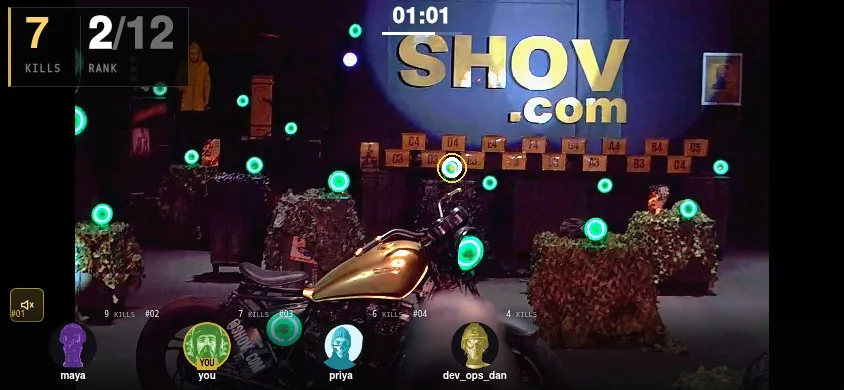
Every participant gets the same controls. Each person opens the event invitation on their own phone or laptop, controls a real full-auto pneumatic gun turret from that browser and fires less-lethal .68 caliber rounds at sensor targets. Players click or tap active green targets; confirmed projectile impacts count as kills, and the most confirmed kills wins the 90-second match. A live AI announcer calls every match, and the company leaderboard carries every region's results through the whole window.
A sample three-region schedule, converted to the arena clock
The plan below is for Thursday, November 19, 2026, a date on which North America and Europe are both on standard time. The arena window is one 10-hour pass, 01:00–11:00 MST (08:00–18:00 UTC). Each block is two to three hours inside the named office's working day, and the third column shows the same block for other offices that keep similar hours. An office whose hours fall outside its region's block books its own block or session. The open window in the middle is for early East Coast arrivals, late European players and anyone at home who wants another turn. Times were converted at render time from each city's IANA time zone.
| Block | Local office hours | Also reads as | Arena clock (America/Denver) | UTC |
|---|---|---|---|---|
| Asia-Pacific block | Singapore 16:00–18:00 | Bengaluru 13:30–15:30; Hong Kong 16:00–18:00 | 01:00–03:00 MST | 08:00–10:00 |
| Europe block | London 10:00–13:00 | Paris 11:00–14:00; Berlin 11:00–14:00 | 03:00–06:00 MST | 10:00–13:00 |
| Open window (any region, home workers) | Denver 06:00–08:00 | New York 08:00–10:00; London 13:00–15:00 | 06:00–08:00 MST | 13:00–15:00 |
| Americas block | New York 10:00–13:00 | Chicago 09:00–12:00; Denver 08:00–11:00 | 08:00–11:00 MST | 15:00–18:00 |
An Australian office reads the Asia-Pacific block as 19:00–21:00 in Sydney. Starting the pass earlier to give Sydney a daytime block also ends the 10-hour window earlier, before the Americas block, so the default for a Sydney office is its own per-person session inside Sydney office hours, with its results carried into the same tournament sheet. The planner lists start times on any half hour in your own time zone, so you pick the start that places each office's block inside its working hours.
Organizer plan: how the tournament runs inside the blocks
Shov runs the matches, shows a round board after each match and, on a day pass, ranks every player on one company leaderboard. The organizer turns that into a tournament. The format below is a plan you manage in your own channels and documents, not a setting inside the event.
- Qualifying in each regional block. Everyone in the region plays at least two matches during their block. Matches hold up to 12 players, run 90 seconds and start back to back, so a 2-hour block offers 960 player slots; a 60-person region has room for several turns each. After a match a player returns to the lobby, sits out the next match, then rejoins the queue. Qualifying closes 30 minutes before the block ends.
- Regional top table. After each match, players report the confirmed kills shown on the round board to their region's scorekeeper, who records each player's best qualifying match in the shared tournament sheet. At the qualifying cutoff the top four players per region are that region's finalists; players tied for fourth place all qualify, since the finalist half hour is an open queue.
- Finalist half hour at the end of each block. In the last 30 minutes of its block, after qualifying has closed, each region's four finalists queue for their final matches alongside anyone else still playing. Shov fills every match from the lobby, so a final is a scored window rather than a private head-to-head; the scorekeeper records each finalist's best confirmed-kill match from that half hour.
- One championship rule. The regional champion is the finalist with the highest confirmed-kill match in the finalist half hour. If two finalists tie, the higher qualifying best wins; if that is also equal, they share the regional title. The company champion is the highest of the three regional champions, with the qualifying best as the tie-break and a shared title when both figures are equal. Every figure comes from the tournament sheet, which the scorekeepers fill from the round boards; Shov's company leaderboard ranks everyone in the booking but is not a per-block table.
- Office trophy. Add every player's best qualifying match per region, divide by the region's headcount, and the highest average wins the office trophy. Home workers count with the region whose hours they keep.
Budget: per-person sessions or one day pass
Per-person sessions are priced by group size with a $500 minimum per session. Current tiers per person: 2–19 people $50; 20–49 people $40; 50–99 people $35; 100–199 people $30; 200+ people $25. Each $50 of a booking buys one complete arena match, and a per-person session runs its matches as one continuous block. Day passes reserve the arena for a fixed window at a fixed price. All prices are in USD.
| Region | People | Session total | Per person | Matches | Block length | Matches per person |
|---|---|---|---|---|---|---|
| Asia-Pacific | 60 | $2,100 | $35 | 42 | 63 min | 8.4 |
| Europe | 80 | $2,800 | $35 | 56 | 84 min | 8.4 |
| Americas | 100 | $3,000 | $30 | 60 | 90 min | 7.2 |
| Three regional sessions | 240 | $7,900 | $32.92 | 158 | 237 min | — |
The two- and three-hour blocks in the schedule table are the day-pass plan. A region that books its own per-person session has a shorter block, the session length in the table above, so run the same plan inside it: start the session at the beginning of the region's office block, close qualifying 30 minutes before the session ends and use the last 30 minutes as the finalist half hour. The table below converts each regional session in this example.
| Regional session | Local start | Qualifying closes | Finalist half hour | Session ends |
|---|---|---|---|---|
| Asia-Pacific, 63 min | Singapore 16:00 | 16:33 | 16:33–17:03 | 17:03 |
| Europe, 84 min | London 10:00 | 10:54 | 10:54–11:24 | 11:24 |
| Americas, 90 min | New York 10:00 | 11:00 | 11:00–11:30 | 11:30 |
The same 240 people booked as one per-person session cost $6,000: 120 matches in one 180-minute block, which suits a company whose regions overlap for that long. For a window that has to span three regions' office hours, compare the day passes.
| Plan | Arena time | Matches | Player slots | Total, USD | Per expected person at 240 |
|---|---|---|---|---|---|
| Three regional per-person sessions | 237 min in three blocks | 158 | 1,896 | $7,900 | $32.92 |
| 5-hour pass (Asia-Pacific and Europe blocks) plus an Americas per-person session | 5 h continuous, 01:00–06:00 MST, plus 90 min | 260 | 3,120 | $11,000 | $45.83 |
| 10-hour pass covering all blocks | 10 h continuous, 01:00–11:00 MST | 400 | 4,800 | $14,000 | $58.33 |
The 10-hour pass is the plan that keeps the arena open for every block and the open window with one booking and one invitation. At 240 people it offers 20 available player slots per person across the day; at 500 people, 9.6. The 5-hour pass at $8,000 covers two adjacent regions, 01:00–06:00 MST in this plan, and the third region books its own session. Larger companies get more from every option: the whole-company tiers and the fixed passes are built for them.
| Private window | Fixed total, USD | Matches | Player slots | Slots per person at 240 | At 500 | At 1,000 |
|---|---|---|---|---|---|---|
| 5 hours | $8,000 | 200 | 2,400 | 10 | 4.8 | 2.4 |
| 10 hours | $14,000 | 400 | 4,800 | 20 | 9.6 | 4.8 |
Organizer checklist
- Pick the date and name one reference zone. Put the arena window in America/Denver and in UTC on the invitation, then list each region's block in its own local time. Avoid dates near a daylight-saving change in any region.
- Book the window in the planner. Select the day pass or the per-person sessions, choose a start time in your own zone on any half hour, and confirm the arena window matches the schedule table above.
- Assign a regional captain and scorekeeper. Each region needs one person to open the invitation on a shared office screen, run the block and record the top table in the tournament sheet.
- Count home workers with a region. Everyone at home joins the block whose hours they keep and appears on that region's top table.
- Send the invitation with the full schedule. A day pass has one private event link and one leaderboard; separate regional sessions each have their own link and leaderboard, so send each region its own link and combine the results in the shared sheet. Include each block in local time, the tournament rules and where the standings live.
- Brief the controls once. Each player needs a supported phone or laptop browser (Chrome, Safari, Edge or Firefox) and a stable connection. Click or tap an active green target; the gun turret turns and fires. After a match, players return to the lobby, sit out the next match, then rejoin the queue.
- Close each block with its finalist half hour, then announce the regional champions, the company champion and the office trophy at the next all-hands, with the recap video and leaderboard image Shov sends after the window closes.
Shov supplies the private arena, the matches, the live AI announcer and the company leaderboard. The organizer owns the blocks, the tournament rules, the sheet and the trophies.
FAQ
Can offices in Asia, Europe and the Americas all play on the same day inside office hours?
Yes, for offices whose hours fit the blocks. The arena at the US range runs 24/7 and a booking can start on any half hour in your own time zone. One 10-hour pass at 01:00–11:00 MST gives Singapore a late-afternoon block, London a late-morning block and New York a mid-morning block, with an open window between them. An office with other hours gets its own block, an earlier or later start, or a separate per-person session.
Is this one event or several?
On a day pass it is one event: a single booking with a single invitation, and its company leaderboard runs for the whole window, so a kill in Singapore and a kill in New York rank on the same table. Separate regional sessions are separate bookings, each with its own link and leaderboard; the organizer combines their results in the tournament sheet. Either way, the regional blocks are the organizer's schedule for who plays when.
How is this different from a distributed company league?
A league repeats across weeks or months with standings carried forward. This tournament is a single cross-time-zone day with regional qualifying, a finalist half hour in each block and a champion announced at the next all-hands. The same regional blocks can become the fixtures of a league afterwards.
What does it cost for 240 people in three regions?
Booked as three regional per-person sessions: $7,900 for 158 matches. Booked as one 10-hour pass that covers every block: $14,000 for 400 matches and 4,800 player slots. A 5-hour pass for two regions plus a per-person Americas session is $11,000. All prices are in USD; the planner shows the live quote.
What do players need?
A supported phone or laptop browser and a stable internet connection. Each player controls a real full-auto pneumatic gun turret at the US range from that browser, firing less-lethal .68 caliber rounds at sensor targets. No app install and no office hardware beyond an optional shared screen.
Can we add more time in one region?
Yes. A per-person session can add matches at $50 each, and a region with a large roster can book its own session before or after the pass. Extra matches can improve qualifying scores only if they finish before that region's qualifying cutoff: when you extend a per-person session, move its cutoff and finalist half hour to the new end time before play starts, and announce both. Scores from a region's designated finalist half hour always stay in the tournament sheet. Other play after a region's cutoff, and any separate session booked after the pass, is for fun and stays out of the tournament sheet, which is the figure the finalists, the tie-breaks and the office trophy use.